
In a rugby match, one of the most notable set pieces is the lineout. With players from both teams lined up in a narrow channel, and some being hoisted into the air, it’s a spectacle that even newcomers to the game will find entertaining. But when exactly does the lineout happen, and what are the laws that govern it? This guide will introduce you to the basics of the lineout in rugby, when it happens, and how it’s done so you can better understand the next time you step on the pitch or spectate a game.
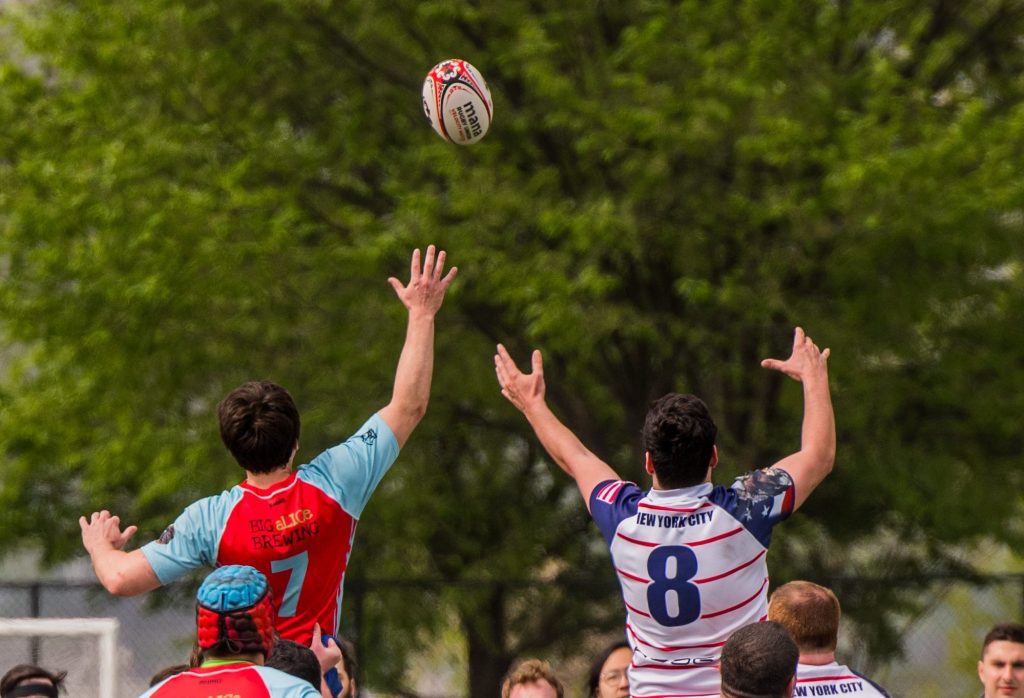
What is a lineout?
The lineout is a set piece that restarts the game after the ball crosses the touch line, is carried into touch by a player, or, in some instances, is kicked into touch. In a lineout, one team throws the ball in while both sides contest for possession. The throwing team has an advantage at retrieving possession of the ball, as the thrower can signal to their team members where they intend to throw and help to synchronize the timing of their team’s jump as they throw it in.
There is a lot of rugby jargon in this article. For definitions, check out our rugby terms glossary.
How a lineout works
When the ball crosses into touch, a lineout will follow. World Rugby laws require that a minimum of two players from each team are required to form a lineout, standing opposite one another from the 5 meter line to the 15 meter line with a narrow gap about a half meter between them. The team throwing determines the maximum number of players that can be in the lineout — if they use five players, the defense can use up to five players. However, up to eight players can be used in a lineout if the throwing team elects to use them.
The player throwing the ball in (often, but not always, the hooker) must stand with both their feet on the mark of touch where the ball exited play, not re-entering the pitch until the ball is thrown. When thrown, the ball must enter the lineout straight in the narrow gap between each team. It must also cross the 5 meter line. The thrower must also not pretend to throw the ball to attempt and deceive the defensive players.
All players that are not in the lineout must remain 10 meters behind the mark of touch on their own team’s side of the pitch. Once the ball is played out of the lineout, these players may advance. This is similar to the rule that keeps players 5 meters behind the back of a scrum until the ball comes out. Should a ruck form, these players must remain onside under the normal laws of the game.
Who throws the ball in?
In most cases, the opponents of the team that last touched the ball prior to it crossing the touch line will be the ones to throw the ball into the lineout, however there are some notable exceptions to this rule. These include when a ball is kicked into touch after a penalty is awarded and a 50:22, in which case the kicking team throws the ball into the lineout.
What are rugby lineout positions?
There are no set positions in a lineout and a team may develop their lineout as they see fit, so long as they adhere to the rules above. However, there are some common themes you may encounter when playing or watching rugby. The following are not requirements, but are among the most common ways a team forms a lineout:
- Hooker: The hooker often throws the ball into the lineout from the mark where it went into touch.
- Props: The props tend to be lined up in the first and third position of the lineout and most often lift the jumpers when the ball is thrown.
- Locks: The locks tend to be lined up in the second and fourth positions and are usually the jumpers, as they tend to be the tallest players.
- Number eight: The number eight tends to line up in the fifth position to serve as an additional lifter, or at the back of the lineout in case a ball is overthrown.
- Flankers: The flankers tend to be used to cover overthrows or serve as additional lifters or jumpers based on the needs of the team.
Again, these are by no means required positions, just a tendency that many teams abide by. However, clever teams can use the opposition’s expectations around these tendencies to deceive them, so always be prepared for a lineout that looks different than what is described above.
Not familiar with rugby positions? Check out our handy guide to learn which players are on the pitch and what their roles are in a rugby game.
What happens after a lineout?
There are a few things that can happen after a lineout, most commonly including playing it directly off the top to the scrum-half below or bringing it down to form a maul. Let’s examine each of these scenarios.
When a jumper collects the ball, their scrum-half is generally located a few meters behind the lineout. A jumper may immediately pass the ball down to their scrum-half, who can start the attack by running or passing the ball out to another teammate. Many teams have set “strikes” or movements that create several options to attack gaps in the defense immediately upon securing possession.
If a jumper elects to bring the ball down, it is common for a team to initiate a rolling maul. A maul occurs when one player is bound on to by a teammate and driven forward, with other teammates piling in to build momentum as the defense does the same to stop their progress. Mauls can be somewhat complex, so rather than derail this article we’ve created this guide to the maul in rugby for further reading.
Finally, the defense can of course steal possession of the ball in a lineout. Should this happen, the team that threw the ball in must adjust to play defense, while the team that stole possession reorganizes on the attack. Stealing the ball consistently in a lineout can be a highly effective way to disrupt an opponent’s gameplan, as losing set pieces repeatedly makes it extremely difficult to win a rugby match.
Line up for the lineout
Now that you understand the basics of a lineout and a couple of the common scenarios that surround this set piece, you’re ready to line up and play it for yourself (or simply watch with an informed perspective, if you prefer to spectate.) Whether you’re a rugby player or a rugby fan, the lineout is a crucial part of the game to understand and a strong lineout can directly lead to a team’s success on the pitch in open play.
Queens Rugby is a New York rugby club based in western Queens, playing and practicing out of Randall’s Island and Astoria in NYC. For more information, contact Queens Rugby today.
 Queens Rugby Club